Karda
A downloadable game
KARDA
A two-player strategy game played with a standard deck of cards.
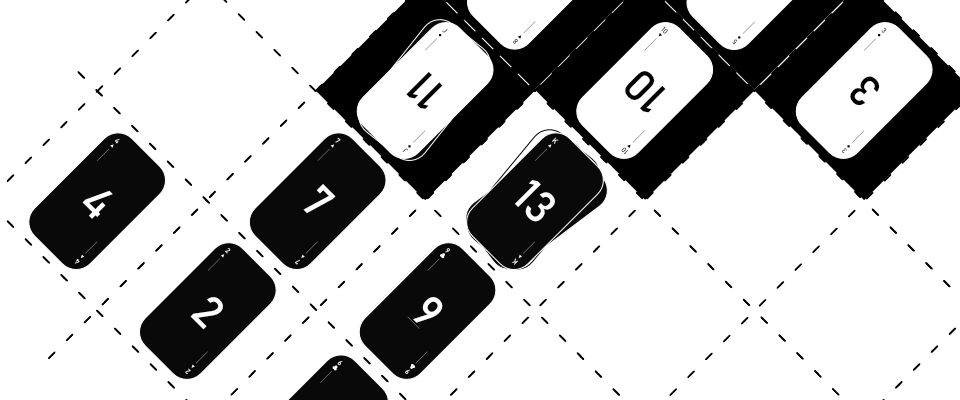
Karda is an abstract area-control game in which two players compete for control of a 5 × 5 board. Each player commands one colour of a standard deck and places cards onto the board to claim territory, capture opposing cards, and restrict their opponent's options.
Number cards gain territory through strength: higher value cards can capture lower value ones. Face cards have their own movement and positional rules, introducing different ways to attack, reposition, and control the board.
The game ends when a player is unable to play any of their cards (automatically lose), or when the deck runs out, whereupon the player controlling the most spaces wins.
All that is required to play is a standard 52-card deck. Or alternatively, use the oficially themed deck.
About the game
Although Karda uses ordinary playing cards, it plays more like an abstract board game than a traditional card game. Cards occupy physical positions on the board, and their value, movement, and relationship to neighbouring cards determine where they can be played.
Players begin with five cards in hand and draw a replacement after every turn. This gives each player several possible moves without providing complete information or complete control over what will become available.
The result is a game of positioning and territory in which players must work with the cards they draw while anticipating how the board may develop.
Setup
- Separate the deck into red and black cards.
- Each player takes one colour, shuffles their cards, and places them face down as their personal deck.
- Each player draws five cards. Hands are kept hidden from the opponent.
On your turn
A turn consists of two steps:
- Choose a card from your hand and place it according to its placement rules.
- Draw a card from your deck to return your hand to five cards.
Some cards have additional effects which are resolved immediately after they are played, see blow.
Cards
Number Cards
Number cards represent the strength occupying a territory. A higher-valued card may capture a lower-valued opposing card when legally placed upon its space.
Face cards and Aces follow additional rules.
Ace
The Ace may only be placed diagonally from one of your cards.
When capturing, the Ace has a value of 14, allowing it to capture any numbered card or face card, including a King. Once placed on the board, however, its value becomes 1.
In the example below, the Ace may be placed on any ✓ space relative to ♣:
✓ | ✓ | |
|---|---|---|
♣ | ||
✓ | ♠ | ✓ |
King
The King may be placed in any of the eight spaces surrounding one of your cards.
It may capture any opposing card except another King. It may not be placed on a space occupied by one of your own cards.
In the example below, the King may be placed on any ✓ space relative to ♠, but not on ♣:
✓ | ✓ | ✓ |
✓ | ♠ | ✓ |
✓ | ♣ | ✓ |
Queen
When the Queen captures a card, she must subsequently exchange positions with another card or an available empty space according to her movement rules.
In the example below, after capturing ♥, the Queen must swap with one of the indicated spaces:
✓ | ||
✓ | ♥ | ✓ |
✓ |
Jack
The Jack moves by jumping over one adjacent card in any direction and landing in the space immediately beyond it.
If the destination contains an opposing card of lower value, the Jack captures it.
In the example below, the Jack moves from ♠, jumps over an adjacent card, and lands on a ✓ space:
✓ | ||
♦ | ||
♠ | ♥ | ✓ |
How the game plays
The central goal in Karda is not which card to play, but where to establish control.
A move can expand your territory, capture an opposing card, provide a new position from which later cards can be played, or deny your opponent access to part of the board. Because both players are building on the same 5 × 5 grid, each placement changes the possibilities available to both sides.
This creates a continuous contest over position. Taking a space may be useful immediately, but its greater value may be in opening a route into another part of the board. Likewise, occupying the right square can prevent an opponent from making a stronger move later.
Face cards introduce exceptions to the normal contest of numerical strength. A Jack can reach by crossing occupied spaces, a Queen can alter the position of cards already in play, a King controls the spaces surrounding it, and an Ace can defeat even the strongest cards when first played.
The five-card hand adds an element of uncertainty without removing the ability to plan. Players know their current options but not which cards will become available next, so strategies must be adapted as the game develops.
Games are often decided by only a few spaces. Empty territory may become inaccessible, an opponent may hold a position that cannot currently be captured, and the cards available in hand may make some routes more practical than others.
For players familiar with games such as Chess or Go, Karda uses a similarly spatial approach: position and access to territory matter as much as the individual strength of a piece. The difference is that the pieces available to you are determined by your hand rather than being completely known from the beginning.
Kind words from testers
"The vast majority of card games conceptually use them as value counters and rarely, if ever, consider them spatially. This nice conceptual leap makes Karda a very fun and unique experience." — Average Joe Hero, averagejoehero.com
“In my 20 years of running a boardgame store, and through all the demos I’ve been asked to play and sell, I’ve only said this twice before, and both times, they became best sellers: This game has actual and real potential." — Måns Andersson, WorldOfBoardGames.se
"Like chess meets Go, with cards! Deceptively deep yet mechanically simple, every move is tight, demanding thought and punishing mistakes. All from a standard deck, blending the feel of classic card play with the richness of a full board game. Honestly, well done!" — Gustav Skogslund, local boardgame designer
Help my game grow?
Karda was intentionally designed to be played with components most people already own. The rules are free, and any standard 52-card deck can be used.
If you tried the game, please rate it on https://boardgamegeek.com/boardgame/448970
About the designer
Designed by Sebastian Sparfvinge
I’m from Sweden, and like my grandfather before me, have spent most of my years on this planet developing games or gaming in one form or another.
While game design has been part of my life since forever, Karda is the first of my designs that I've made publicly available, after considerably more encouragement from friends and family than should probably have been necessary.
Download
Click download now to get access to the following files:
Development log
- from crowns to karda1 day ago
- Changed formatSep 21, 2025
- Swapping the rules back, with a slight adjustment.Sep 11, 2025
- fixed the pdf.Sep 04, 2025
- A quick updateSep 02, 2025
- Change to a core ruleAug 29, 2025
- Switching Ace and KingAug 24, 2025

Leave a comment
Log in with itch.io to leave a comment.